
Choosing Between Flexible Hours and a Fixed Weekly Block for Your Practice
As a clinician, how you structure your schedule shapes more than your calendar. It impacts your income stability, energy, and long-term sustainability. Many therapists and counselors today are running hybrid practices, combining virtual sessions from home with a limited number of in-person client hours each week.
That hybrid reality raises an important question: Is it better to book flexible hours as needed, or commit to a fixed weekly office block?
If you practice in Lancaster County, PA, this decision also carries real financial weight. Full-time office leases often don’t align with part-time, in-person work. This post walks through both options so you can choose the structure that best supports your clients, your budget, and your capacity.
Understanding Flexible Hours for Hybrid Clinicians
Flexible hours allow you to reserve office space only when you need it, rather than committing to the same day and time every week.
Benefits of flexible office hours
Supports variable schedules and occasional in-person sessions
Allows space for crisis sessions or last-minute client needs
Reduces overhead by paying only for hours used
Helps prevent burnout by fitting work around personal life
Challenges to consider
Income may feel less predictable if clients want standing appointments
Requires more intentional boundary setting
Can make weekly routines harder to establish
Flexible hours work especially well for clinicians whose practices are primarily virtual and who want occasional, professional in-person space without carrying unused overhead.
The Appeal of a Fixed Weekly Office Block
A fixed weekly block means reserving the same office day and time each week, creating consistency for both you and your clients.
Benefits of a fixed block
Builds trust through predictability (for example, every Tuesday 9–5)
Makes scheduling and marketing easier
Supports routine and productivity
Often leads to steadier monthly income
Trade-offs to weigh
Less flexibility for schedule changes or emergencies
Can feel restrictive during slower seasons
Full-time leases are often underutilized in hybrid practices
For clinicians with a strong in-person caseload, fixed blocks can be grounding. The challenge is choosing a structure that doesn’t require paying for unused space.
Office Rental Costs in Lancaster County, PA: What the Numbers Say
This is where many clinicians feel the disconnect. If most of your work is virtual, renting a full-time office for one or two days a week often does not make financial sense.
Full-time office leases
In Lancaster County, small professional offices typically lease for $12–$20 per square foot annually. A modest 200–500 sq ft office can translate to $400–$800 or more per month, before utilities and common area fees.
Serviced offices, such as Regus, often start around $559 per person per month with long-term commitments. For a therapist and one client, that cost doubles quickly, even if the office sits empty most of the week.
Flexible and Part-Time Office Alternatives
For hybrid clinicians, part-time and hourly options are often a better match.
Lancaster Coworking offers day passes and flexible memberships with occasional private office access
Inspire Wellness Collective provides flexible, therapy-ready offices and studios at hourly and bundled rates, with client waiting areas and wellness-specific amenities
Executive office suites and shared workspaces in the region often offer hourly or daily bookings ranging from $40–$75 per hour
These models allow clinicians to reduce costs by 50–80 percent compared to full-time leases, keeping expenses aligned with actual usage.
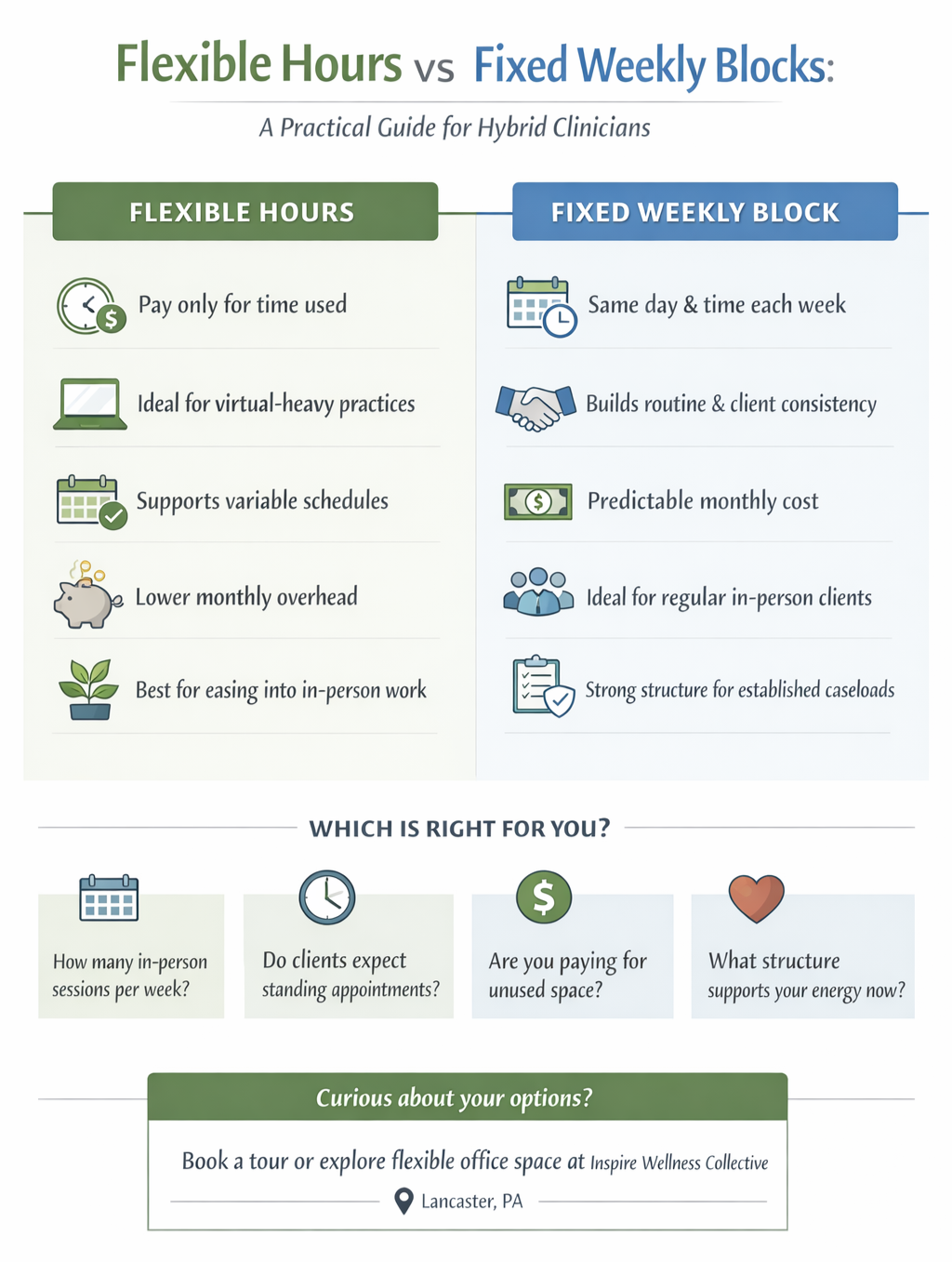
How to Choose What Fits Your Practice Right Now
If you are deciding between flexible hours and a fixed weekly block, consider the stage and rhythm of your practice.
Choose flexible hours if your caseload is mostly virtual or still growing, and you want maximum adaptability
Choose a fixed block if you have consistent in-person demand and value routine
Hybrid strategy: start with flexible hours, track usage for one to two months, then transition into a fixed block if demand supports it
The goal is alignment. Your space should support your clinical work without creating financial pressure or unnecessary stress. Book a tour to see what hybrid space can look like.
A Grounded Next Step
The best scheduling structure is not permanent. It evolves with your practice. The key is choosing options that give you clarity, flexibility, and sustainability as you grow.
Practice Scaling Readiness Assessment
Reflective question:
What schedule structure would support both my clients and my own capacity right now?
Ready to explore flexible options?
If you are practicing in Lancaster County and want to see how part-time or hybrid office space could work for you, consider booking a tour or reviewing flexible membership options.